
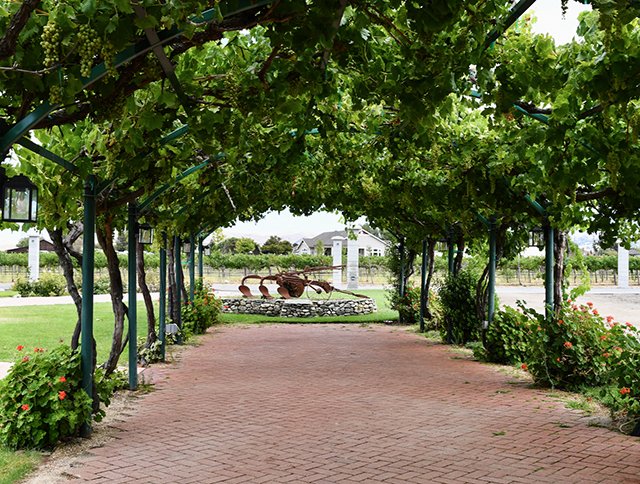
A winery’s history plays a crucial role in the wines it produces today. This legacy is the foundation that the forefathers of each winery give to the present-day owners. How the current generation or new owners interpret what is handed down impacts both the grapes and the winemaking process. It can also make or break the wine producer’s continued success. Such is the case with Concannon Vineyard in the Livermore Valley AVA.

Table of Contents
History of Concannon Vineyard
James Concannon established the winery in 1883 in the Livermore Valley. Not only did James create a winery, but he was also one of the founding fathers who helped place Livermore Valley on the map as a renowned wine-growing region. Little did James know that his winery would play a vital role in California’s Cabernet Sauvignon production. His vineyard now hosts the mother vine of most Cabernet Sauvignon clones throughout California. It began when James had the foresight to import Cabernet Sauvignon vines from the famed Château Margaux in Bordeaux. Today, clones 7, 8, and 11 account for the majority of Cabernet Sauvignon grown in California, and they originated at Concannon.
It was James’s son Joe who persevered through Prohibition and kept the winery going by selling sacramental wine. After Prohibition, many wineries needed cuttings to plant new vines. Those wanting Cabernet Sauvignon looked to Concannon.

In 1961, Joe’s son, Jim, had the insight to produce Petite Sirah as a standalone wine. This idea continues to garner accolades for the wine as it plays a significant role in Concannon’s production.

Concannon in ancient Gaelic means, “Wisdom without compromise.” The Concannon name and winery are fitting of that meaning for many reasons. First, it was James Concannon’s wisdom to come to America and start the winery. He did not compromise on where he located his winery or on the choice of vines; he planted his vineyard.
The family remained steadfast during Prohibition and managed to stay afloat. Finally, James passed this tenacity onto his children and grandchildren. They, too, saw his vision to continue the family legacy. One truly understands after visiting the winery and tasting the wine that Concannon’s philosophy is not to compromise on what is important.
I first met the fourth-generation John Concannon at a dinner at Spago. That meal was my first introduction to the importance this winery played in California’s wine history. At the time, I especially enjoyed a Petite Sirah. Having met this man, whose dedication to preserving his family legacy, it was sad to hear of his passing in 2025. His impact on the winery and Livermore Valley wine will live on.

In December of 2024, the Lemmons Family Vineyards and Darcie Kent Winery purchased the 230-acre property from The Wine Group, which had owned Concannon since 2004.
Concannon Vineyards Legacy
Recently, my visit to Concannon enabled me to revisit the mother vine and appreciate its importance in California’s wine history. In fact, my first stop was to pay my respects to the mother vine. One also recognizes, entering the tasting room, that this winery has a legacy. It becomes even more apparent when one views the winery’s history line along a wall in a hallway alcove, seeing many of the achievements and accolades that were bestowed on Concannon Wines over the years.

Obviously, the most significant achievement is the importance of their Cabernet clones, followed by their gamble on creating Petite Sirah as a single varietal in 1961. Other milestones include: in 1925, Concannon was the first to introduce the varietal wine label on their bottling of Riesling. Joe also had the foresight to hire Katherine Vajda, one of the first trained female winemakers to head a winery team in 1950.
The winery is a California Registered Historical Landmark, which features the Tasting Room, Wine Library, and Club Rooms. The original building displays the plaque. One also recognizes, entering the tasting room, that this winery has a legacy. It becomes even more apparent when one views the winery’s history timeline on a wall in a hallway alcove, which features many of the achievements and accolades bestowed on Concannon Wines over the years.
Concannon Vineyards Today
Many things have changed since my first visit to Concannon. Brett Fikse is the winemaker. His philosophy is to craft complex, harmonious, and age-worthy wines. This fits the general Concannon mission, where it’s about the traditions we honor and our unwavering commitment to excellence.

Under its current ownership, Concannon is undergoing a significant revitalization aimed at restoring its agricultural vitality while preserving its historic legacy. Since my last visit, several new event spaces have debuted, including the Vineyard Ballroom, Bubbles Lounge, and Barrel Room.
Today, the Livermore Valley has designated Cabernet Franc and Sauvignon Blanc as its signature varietals. Both these varieties in the Livermore Valley date back to the 1880s. These grapes were chosen for their historical significance and modern-day popularity.
Concannon has gone outside the box, so to speak, with one of those varieties, Cabernet Franc. They created a Cabernet Franc Blanc. This is one of my favorites at the winery and one not to miss.
Concannon’s latest chapter marks an exciting new acquisition that strengthens both the legacy of Livermore Valley and the future of the Concannon Estate. The Lemmons Family has purchased Cuda Ridge Wines, a boutique winery celebrated for its small-lot, Bordeaux-style wines. As part of this transition, the Cuda Tasting Room will relocate to the Concannon property. Cuda owner and winemaker Larry Dino will join Concannon winemaker Brett Fikse to create a collaborative winemaking team that will guide both brands forward. Cuda is especially recognized for its exceptional red wines, including Carmenere.

The Vineyards
Today, Concannon Vineyard comprises 235 acres. One of the defining characteristics of our land is its remarkably uniform soil consisting of small gravel, which provides excellent drainage and helps vines produce depth and concentration in their fruit.

The varieties grown include varietals across the estate, including Cabernet Sauvignon, Petite Sirah, Sauvignon Blanc, Cabernet Franc, Chardonnay, Sémillon, Malbec, Merlot, Petit Verdot, Pinot Noir, Grüner Veltliner, Albariño, Viognier, Zinfandel, Syrah, Mourvèdre, and Grenache Noir.
This year, Concannon will plant approximately 50 acres with four distinct Cabernet Franc clones and the Musqué clone of Sauvignon Blanc.

Sustainability
The winery is sustainable and was one of the first 17 wineries in California to obtain certification. Sustainability for Concannon encompasses not only environmental practices and reducing its carbon footprint, but also represents the preservation of the original winery and the mother vine, as combining both the past and the present plays a vital role in the winery’s future.

Concannon Livermore Valley Wines
It is interesting to see how the wines compare to those I tasted in 2017 to my most recent tasting. Of course, the winemaker changed, the vintages brought different conditions, and my palate has changed as well.
In 2017, I wrote about the Rose of Petite Sirah, Malbec, and the Mother Vine Cabernet Sauvignon. I know I brought home the Malbec and Petite Sirah to savor at another time. Today, I still enjoyed the Malbec, Mother Vine Cabernet Sauvignon, and the Petite Sirah. In the reds, I was especially taken with the Mother Vine Cabernet Sauvignon.
2020 Mother Vine Cabernet Sauvignon: This wine blends 90% Cabernet Sauvignon and 10% Merlot, and aged in 55% neutral, 27% new American, and 18% new French oak. The wine is smooth and balanced.

The wine that really grabbed me on my visit and has remained my favorite of 2025 and 2026 is the 2024 Cabernet Franc Blanc. It has become my go-to wine. Anyone who knows me knows I am a sucker for anything Cabernet Franc. In this case, I love the refreshing flavors of apples and stone fruit, accentuated with a slight sweetness on the finish. I cannot wait to try the 2025 vintage.

A Pillar of Past and Future Success
Concannon still plays a vital role in California’s wine history as the winery moves into the future. At the same time, this winery’s role is vital to the continued success of the Livermore Valley Wine Region.
Note: As is common in the travel and wine industry, this writer received a hosted wine tasting. While it has not influenced this review, the writer believes in full disclosure.